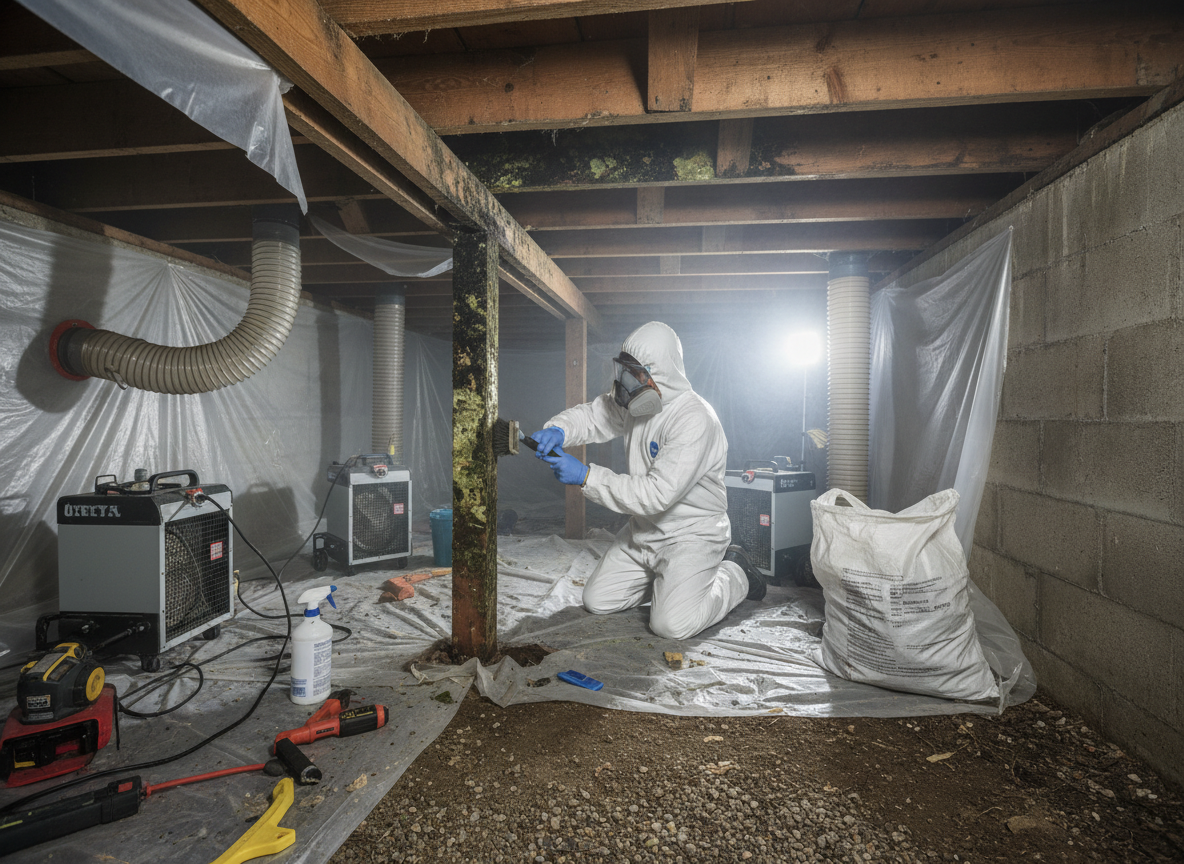
Downey's post-war housing stock along streets near the Downey Civic Theater and Rio Hondo Golf Club often features vented crawl spaces under raised foundations that trap humidity during mild winters. When roof or plumbing leaks occur, moisture lingers because summer heat rarely reaches below the floor joists, allowing mold to colonize insulation and subflooring. Local crews must account for tight access points common in these 1950s-1960s builds and the occasional high water table near Rancho Los Amigos.
Removal begins with containment to keep spores from migrating into living areas, followed by HEPA vacuuming and antimicrobial treatment on wood and soil surfaces. In Los Angeles County, crews also check for code-required vapor barriers that many older Downey properties lack, adding them where missing to prevent recurrence. Work near Bell Gardens or Paramount frequently involves coordinating with nearby utility lines that run close to property boundaries.
Homeowners in the area commonly overlook slow seepage from irrigation systems or poor grading around slab transitions, which feeds mold growth year-round despite the dry summers. Proper drying requires industrial dehumidifiers sized for the confined space and daily moisture readings until levels stabilize below 12 percent. Final clearance testing confirms the space meets habitability standards before insulation is replaced.
Technician insight
In Downey, the thing that catches most people out with Crawl Space Mold Removal is the combination of older vented foundations and the mild winters that never fully dry the space. Homes near Lakewood Blvd often have original dirt floors with no vapor barrier, so even a small roof leak from summer irrigation overspray keeps mold active. Homeowners usually try bleach sprays first, which only drives spores deeper into the wood.
Hidden Mold Under 1960s Home Near Columbia Memorial Space Center
A homeowner noticed musty odors after a minor roof leak during an unusual winter rain. Inspection revealed black mold covering insulation and joists in the crawl space with no vapor barrier present. Crews contained the area, removed affected materials, treated surfaces, installed a sealed vapor barrier, and ran dehumidifiers until readings normalized. The space passed clearance testing and the odor disappeared.
How it works
- 1
Initial Assessment
Technicians enter the crawl space through existing access points to map moisture sources and visible mold extent while checking for structural rot in joists.
- 2
Containment Setup
Plastic barriers and negative air machines isolate the crawl space from the rest of the home to prevent spore spread during removal.
- 3
Removal and Treatment
Moldy materials are removed, surfaces are HEPA-vacuumed, and EPA-registered antimicrobials are applied to wood and soil.
- 4
Drying and Verification
Dehumidifiers and air movers run until moisture readings stabilize, followed by third-party air sampling before the space is returned to service.
Pricing
Cost depends on square footage accessed, depth of mold into insulation, and any required vapor barrier work.